
Essential Security Features of a Secure Customer Portal
About Author

Nisarg Purohit

With 10+ years of experience in digital transformation and enterprise consulting, Nisarg helps businesses build scalable digital platforms across BFSI, NBFC, and Manufacturing. He bridges business strategy with technology to drive innovation, efficiency, and better customer engagement.
August 18, 2026

Not all cyberattacks begin with complex malware; sometimes, all it takes is a compromised password or an unsecured API. As customer portals become the primary gateway for customers to access accounts, documents, and support services, securing these digital touchpoints has become a business imperative. A security-first customer portal protects sensitive data, fosters customer trust, and helps organizations remain resilient against evolving cyber threats. In this blog, we’ll explore the essential security features every secure customer portal should include.
Why Secure Customer Portals Are Essential
Organizations across industries rely on customer portals to simplify service delivery, improve customer engagement, and streamline communication. Whether it’s a financial institution providing account access, a healthcare provider managing patient information, or a manufacturing company supporting distributors, these portals often house highly sensitive customer and business data.
As digital interactions continue to grow, customer portals have become attractive targets for cybercriminals. Credential theft, phishing attacks, ransomware, API exploitation, and unauthorized access attempts are increasingly common, making customer portal security a strategic priority rather than simply an IT concern.
Without robust security controls, organizations risk:
- Unauthorized access to sensitive customer information
- Data breaches resulting in financial and operational losses
- Regulatory penalties for non-compliance
- Damage to brand reputation
- Loss of customer trust and loyalty
Beyond protecting against cyberattacks, a secure customer portal demonstrates an organization’s commitment to safeguarding customer information. Customers are far more likely to engage with businesses they trust to protect their data.
In addition, regulations such as GDPR, India’s Digital Personal Data Protection (DPDP) Act, 2023, HIPAA, PCI DSS, and industry-specific compliance standards require organizations to implement appropriate security controls to protect sensitive information and maintain regulatory compliance. Organisations operating in India must also ensure lawful processing of personal data, obtain valid consent where required, and implement appropriate safeguards in line with the DPDP Act.
Ultimately, adopting a security-first approach enables businesses to deliver trusted digital experiences while minimizing cybersecurity risks, protecting valuable data, and strengthening customer confidence.
Key Security Features Every Customer Portal Should Have
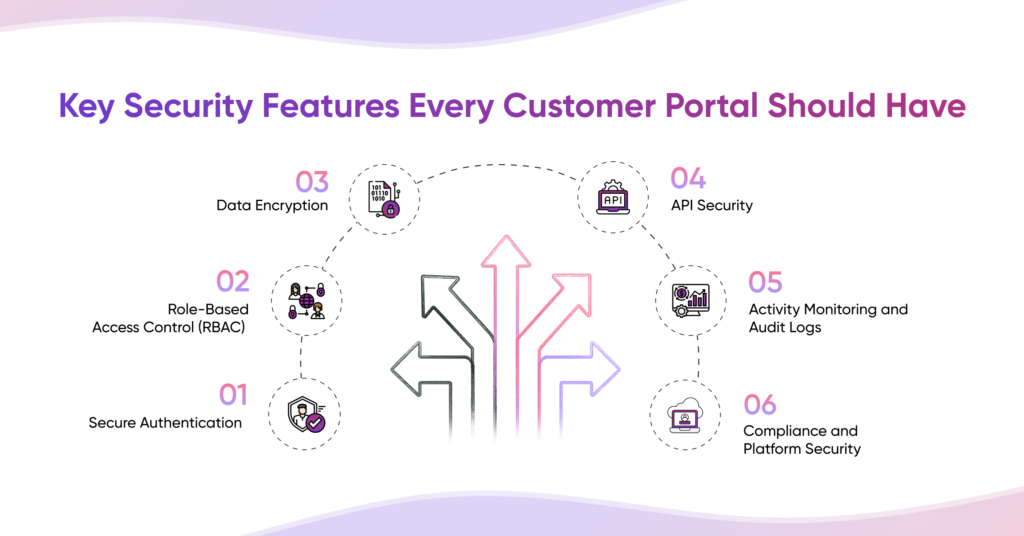
Modern Secure Customer Portal Solutions should combine multiple layers of security to protect against evolving threats while delivering a seamless customer experience.
- Secure Authentication
Authentication serves as the first line of defense against unauthorized access. Strong identity management helps ensure that only verified users can access sensitive customer information.
Every Enterprise Customer Portal should support:
- Multi-Factor Authentication (MFA)
- Single Sign-On (SSO)
- Strong password policies with complexity and expiration controls
- Account lockout after repeated failed login attempts
- Secure session management
Organizations using Liferay DXP benefit from enterprise-grade authentication capabilities, including support for OAuth 2.0, OpenID Connect, LDAP, and SAML. Liferay also supports Multi-Factor Authentication (MFA), including email-based one-time passwords (OTP), time-based OTP (TOTP), and FIDO2 authentication, enabling organizations to strengthen identity verification while maintaining a seamless user experience.
- Role-Based Access Control (RBAC)
Not every user should have access to the same information. A secure customer portal should enforce Role-Based Access Control (RBAC) to ensure users only access the information relevant to their responsibilities.
Key capabilities include:
- Granular user roles and permissions
- Department-, customer-, or partner-specific access
- Restricted administrative privileges
- Secure access to confidential documents, transactions, and applications
Liferay DXP extends traditional RBAC with organizations, sites, teams, and user groups, allowing administrators to define granular permissions at the page, application, document, and content levels. This flexible permission model helps organizations securely manage access across customers, partners, vendors, and employees.
- Data Encryption
Sensitive information should remain protected both while it is being transmitted and while it is stored.
A secure customer portal should provide:
- Encryption of data in transit using HTTPS and TLS protocols
- Support for protecting sensitive data at rest through secure database, storage, and infrastructure encryption
- Secure communication between integrated applications
- Protection against data interception and unauthorized disclosure
When combined with secure infrastructure and encryption best practices, these measures significantly reduce the risk of sensitive customer information being exposed.
- API Security
Modern customer portals rely extensively on APIs to connect with CRM platforms, ERP systems, payment gateways, identity providers, and third-party applications. Since APIs are a common attack vector, securing them is essential.
A secure customer portal should include:
- Secure REST and GraphQL APIs
- OAuth-based authentication and authorization
- Input validation
- Rate limiting
- API monitoring and logging
Liferay DXP provides secure REST and GraphQL APIs protected through OAuth 2.0, configurable permissions, authentication tokens, and Service Access Policies (SAP), enabling organizations to build secure enterprise integrations while maintaining strict access controls.
- Activity Monitoring & Audit Logs
Security doesn’t end after authentication. Continuous monitoring helps organizations detect suspicious behavior before it becomes a major security incident.
Essential monitoring capabilities include:
- User activity tracking
- Login monitoring
- Detailed audit trails
- Security event logging
- Threat detection and alerting
Comprehensive audit logs provide visibility into user actions, simplify compliance reporting, and support faster incident investigation. Combined with proactive monitoring, organizations can identify unusual activity early and respond before it impacts customers or business operations.
- Compliance & Platform Security
Cybersecurity is constantly evolving, making continuous platform maintenance just as important as implementing security controls.
Organizations should look for customer portal platforms that provide:
- Support for GDPR, the Digital Personal Data Protection (DPDP) Act, 2023, and other applicable global and regional privacy regulations
- Capabilities that help organizations build solutions aligned with industry requirements such as HIPAA
- Regular security updates
- Vulnerability management
- Patch management
- Long-term platform support
Liferay DXP follows secure development practices and regularly releases security updates, patches, and advisories to address emerging vulnerabilities. Combined with ongoing maintenance, these capabilities help organizations keep their customer portals secure, reliable, and compliant over time.
How Secure Customer Portals Build Trust and Business Resilience
Security is more than a technical requirement, it’s a competitive advantage that strengthens customer relationships and supports long-term business growth.
A well-designed Secure Customer Portal helps organizations:
Increase Customer Trust
Customers are more likely to engage with businesses that demonstrate a strong commitment to protecting their personal and business information.
Reduce Cybersecurity Risks
Layered security controls minimize the risk of unauthorized access, ransomware, phishing attacks, and data breaches.
Strengthen Regulatory Compliance
Built-in security features help organizations meet regulatory requirements while reducing the likelihood of costly compliance violations.
Improve Business Continuity
Secure customer portals reduce downtime caused by security incidents and help organizations maintain uninterrupted digital services.
Enhance Brand Reputation
Organizations known for protecting customer data build stronger relationships, increase customer loyalty, and differentiate themselves in competitive markets.
Deliver Secure Digital Experiences
Customers enjoy seamless self-service experiences without compromising the security or privacy of their information.
Together, these benefits help organizations strengthen resilience while building lasting customer trust.
Choosing the Right Secure Customer Portal Solution for Your Industry
Choosing the right customer portal goes beyond functionality, it requires evaluating the platform’s security capabilities, scalability, and long-term reliability.
When evaluating Secure Customer Portal Solutions, look for:
- Enterprise-grade security architecture
- Identity and access management
- Granular Role-Based Access Control (RBAC)
- Multi-Factor Authentication and Single Sign-On
- Secure REST and GraphQL APIs
- Compliance support
- Scalable, cloud-ready architecture
- Regular security updates and patch management
- Ongoing support and maintenance
- Proven expertise implementing secure customer portals on enterprise platforms such as Liferay DXP
Selecting a platform with these capabilities helps organizations build customer portals that remain secure, scalable, and adaptable as business needs evolve.
Why Choose Aixtor Technologies
Building a secure customer portal requires expertise in enterprise architecture, cybersecurity best practices, and platform implementation.
At Aixtor Technologies, we help organizations design, develop, and secure customer portals that deliver exceptional user experiences without compromising security. As a trusted Liferay Solution Partner, we leverage the full capabilities of Liferay DXP to implement robust authentication, granular access controls, secure API integrations, compliance-ready architectures, and scalable security frameworks tailored to your business needs.
From planning and implementation to platform upgrades and ongoing maintenance, our security-first approach ensures your customer portal remains resilient, compliant, and ready to support future business growth.
Conclusion
As organizations continue to accelerate digital transformation, customer portal security must remain a strategic priority. A modern Secure Customer Portal should incorporate strong authentication, granular Role-Based Access Control (RBAC), data encryption, secure APIs, continuous monitoring, audit logging, and ongoing platform security to protect sensitive information and reduce cybersecurity risks.
Investing in a security-first customer portal not only safeguards customer data but also strengthens regulatory compliance, improves business resilience, and builds the trust needed to deliver exceptional digital experiences.
With deep expertise in Liferay DXP and enterprise portal development, Aixtor Technologies helps organizations build secure, scalable, and future-ready customer portals that support long-term digital success.
Latest Blogs
Stay up to date with the latest insights, trends, and best practices in enterprise portal development and digital transformation.


