
B2B Commerce Trends Every Manufacturer Should Know in 2026
About Author

Nisarg Purohit

With 10+ years of experience in digital transformation and enterprise consulting, Nisarg helps businesses build scalable digital platforms across BFSI, NBFC, and Manufacturing. He bridges business strategy with technology to drive innovation, efficiency, and better customer engagement.
August 24, 2026

Manufacturers are under increasing pressure to serve customers digitally without disrupting the sales, dealer, and distributor relationships that drive their business. B2B buyers expect faster access to products, pricing, orders, technical documentation, and support, while sales teams still need to focus on complex requirements, strategic accounts, and high-value opportunities.
Whether you manufacture industrial equipment, automotive components, chemicals, electronics, or engineered products, customers increasingly expect digital experiences that make routine interactions easier:
- 24/7 self-service access
- Customer-specific pricing and catalogs
- Real-time product and order information
- Easy reordering
- Technical documentation
- Shipment visibility
- Personalized digital experiences
This shift does not mean manufacturers need to replace traditional sales channels with digital commerce. Instead, the opportunity is to connect digital self-service with sales, customer service, ERP, CRM, product information, and other business systems.
A modern B2B commerce experience can help customers complete routine activities independently while giving sales teams better context for more complex conversations.
In this article, we explore the key B2B commerce trends manufacturers should know in 2026, including self-service, AI-powered product discovery, ERP integration, personalization, mobile commerce, connected services, and digital account growth. We will also look at how platforms such as Liferay DXP and Liferay Commerce can support connected customer, dealer, and distributor experiences.
Why Is B2B Commerce Changing So Quickly?
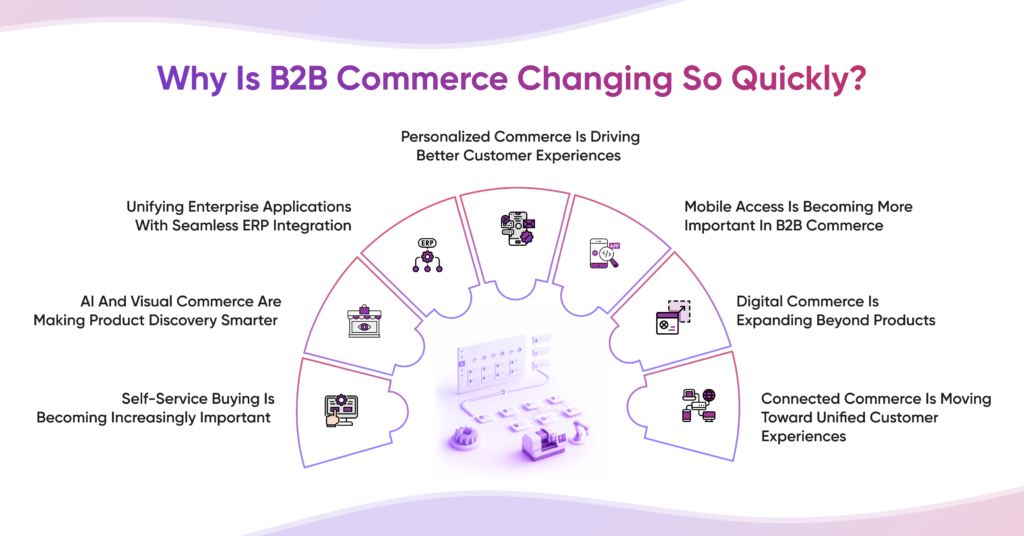
Traditionally, manufacturing sales relied heavily on distributors, field sales teams, emails, spreadsheets, and phone calls.
These channels still play an important role, particularly for complex or high-value purchases. But routine purchasing is increasingly moving toward digital self-service.
Modern B2B buyers want to:
- Check product availability quickly
- Access negotiated pricing
- Download technical documents
- Reorder previous purchases
- Track shipments
- View invoices and order history
- Raise service requests
- Find product information without contacting sales or support
As a result, manufacturers are investing in B2B commerce platforms, customer portals, dealer portals, and self-service experiences that simplify complex purchasing while reducing manual processes.
Trend 1: Self-Service Buying Is Becoming the New Standard
One of the biggest shifts in manufacturing commerce is the move toward digital self-service for routine purchasing and account activities.
Instead of depending on a sales representative for every interaction, buyers can access the information and services they need whenever it is convenient.
This does not eliminate the role of sales teams. Instead, it allows sales professionals to spend more time on strategic accounts, complex requirements, relationship building, and higher-value opportunities.
A modern manufacturing self-service portal can provide:
- Customer-specific product catalogs
- Contract pricing and discounts
- Quick reorder functionality
- Invoice and payment history
- Shipment and order tracking
- Technical documentation
- Service request management
- Account and user management
For manufacturers, this can reduce repetitive manual interactions and improve operational efficiency. For customers, it creates a faster and more convenient purchasing experience.
The business opportunity is broader than simply allowing customers to place orders online. A well-designed self-service portal can become a central digital entry point for commerce, account management, support, product information, and ongoing customer engagement.
Considering a manufacturing customer portal? A connected self-service experience can help manufacturers reduce friction for customers while giving sales and service teams better visibility into customer needs.
Trend 2: AI and Visual Commerce Are Transforming Product Discovery
Manufacturing catalogs can contain thousands of products with complex specifications, attributes, compatibility requirements, and technical documentation.
Traditional keyword search may not always be enough.
AI-powered product discovery can help buyers search using natural language and find relevant products based on specifications, product attributes, customer context, and available business data.
For example:
“Show stainless steel valves compatible with 300 PSI systems.”
Instead of navigating multiple categories and filters, an intelligent search experience can help buyers identify relevant products based on their requirements.
Practical AI Use Cases for Manufacturers
| Business Challenge | AI-Powered Opportunity |
| Large product catalogs | Intelligent product search |
| Complex specifications | Conversational product discovery |
| Repeat purchases | Guided or predictive reordering |
| Customer support | AI-assisted knowledge retrieval |
| Product selection | Personalized recommendations |
| Technical documentation | Contextual information discovery |
Shop by Diagram Simplifies Complex Product Discovery
AI is not the only way manufacturers can simplify product discovery. Visual commerce can also make it easier for buyers to identify complex parts and components.
For manufacturers selling machinery, automotive components, industrial equipment, electronics, or spare parts, customers may know what a component looks like or where it is located but not its exact product name or SKU.
Liferay Commerce’s Shop by Diagram capability addresses this challenge through interactive product diagrams. Manufacturers can provide an exploded view or technical diagram, map individual components to catalog SKUs, and allow customers to select a component directly from the diagram. Liferay Commerce’s Shop by Diagram capability can be used for complex product and spare-parts discovery where customers need to identify components visually.
For example:
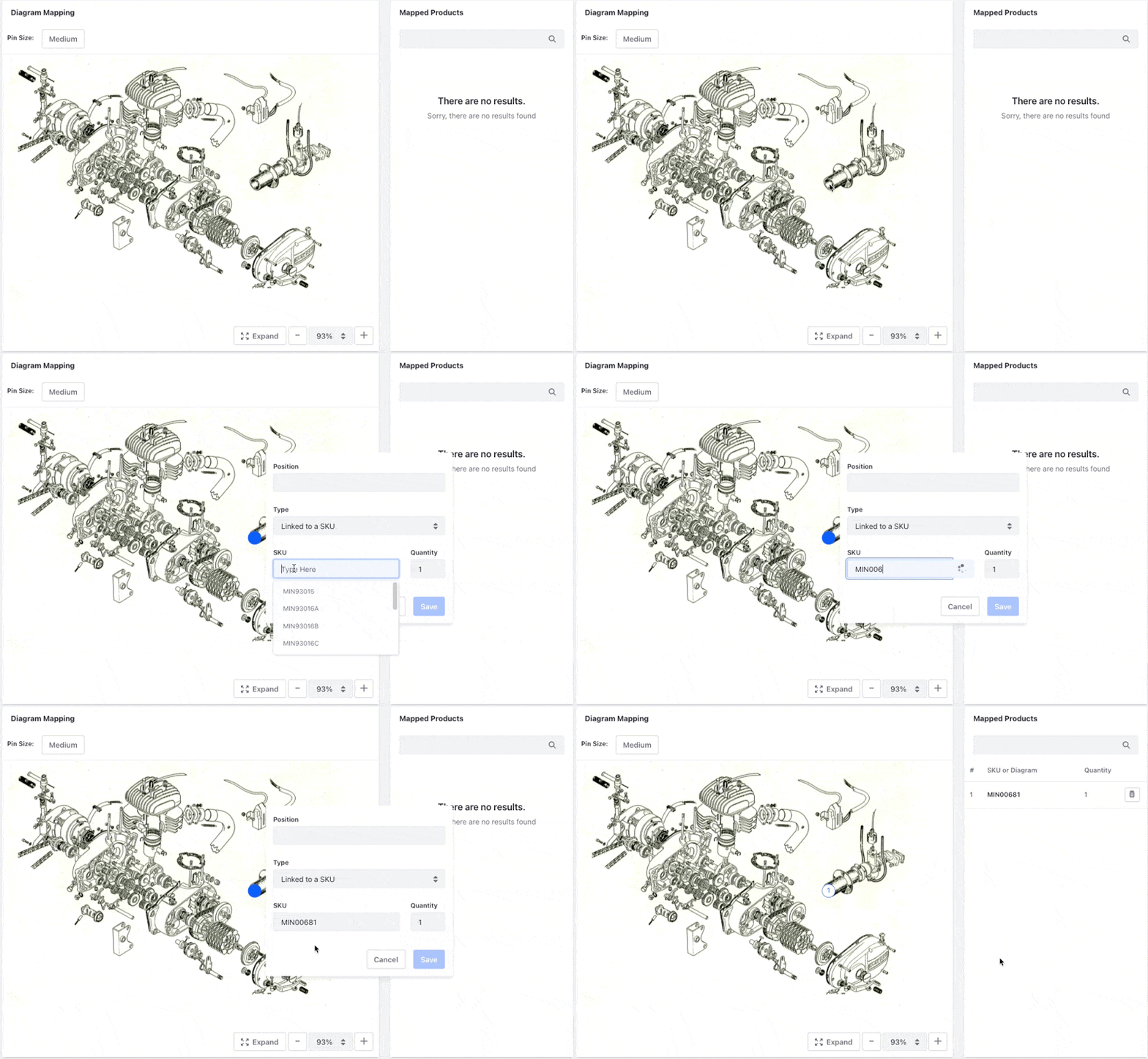
View equipment diagram → Select component → Identify corresponding product → Select quantity → Add to cart
This can make spare-parts discovery easier when customers do not know the exact product name or model number.
Combining AI With Visual Product Discovery
Manufacturers do not need to rely on a single product discovery method. A modern B2B commerce experience can combine:
- Natural-language search for requirement-based discovery
- Faceted search for specifications and attributes
- AI-powered recommendations based on customer and product context
- Shop by Diagram for visual component identification
- Personalized catalogs based on customer accounts and purchasing relationships
The goal is to support different buying behaviors—from customers who know the exact SKU to customers who know what they need but need help identifying the right product.
Liferay Commerce provides capabilities including product data modeling, faceted discovery, product recommendations, and Shop by Diagram to support these experiences.
For manufacturers with complex catalogs, combining intelligent and visual product discovery can reduce search friction and make digital purchasing more intuitive.
Trend 3: ERP Integration Is Creating Connected Commerce Experiences
Manufacturing organizations rarely operate with a single system. ERP platforms manage inventory and financial information, CRM systems manage customer relationships, PIM platforms manage product information, and order management systems handle transactions and fulfillment.
The challenge is not necessarily the number of systems. The challenge is making the right information available to customers, dealers, distributors, and sales teams at the right time.
A connected platform can surface:
- Inventory availability
- Customer-specific pricing
- Order status
- Dealer and distributor information
- Invoice history
- Product availability
- Shipment information
- Customer account data
The goal isn’t necessarily to replace existing enterprise systems.
Instead, manufacturers can connect their digital commerce experience with the systems they already rely on.
This reduces unnecessary data duplication and helps customers access more accurate information through a single digital experience.
Need to connect Liferay with ERP, CRM, PIM, OMS, or other enterprise systems? A well-planned integration strategy can create a connected digital commerce layer without requiring manufacturers to replace the systems already supporting their business.
Trend 4: Personalization Is Becoming Essential in B2B Commerce
Personalization is becoming more than a marketing capability. In B2B commerce, it can help ensure that each customer sees the products, pricing, content, services, and recommendations that match their business relationship with the manufacturer.
For manufacturers managing multiple customer segments, dealers, distributors, regions, and commercial agreements, account-based experiences can make digital commerce significantly more relevant.
Manufacturers can personalize digital experiences based on:
- Customer account
- Industry segment
- Purchase history
- Geographic region
- Dealer or distributor relationship
- Contract agreements
- User role
- Product requirements
Instead of presenting every customer with the same storefront, manufacturers can create experiences aligned with the customer’s business relationship.
The result can be a more relevant buying journey, easier product discovery, and more efficient purchasing.
Want to create more personalized B2B customer experiences? Explore how account-based digital experiences can help manufacturers deliver relevant products, pricing, content, and services to each customer.
Trend 5: B2B Commerce Is Becoming More Mobile and Field-Oriented
B2B commerce does not always happen from an office desk.
Field engineers, warehouse teams, maintenance professionals, sales representatives, and distributors may need to access product information, check orders, reorder products, or request support while working on-site.
As a result, manufacturers are increasingly designing B2B commerce experiences around mobile and field-based workflows, making essential information and purchasing capabilities accessible wherever customers conduct business.
A mobile-friendly B2B commerce experience can allow users to:
- Search products and specifications
- Scan product codes
- Reorder frequently purchased products
- Check product availability
- Track orders and deliveries
- Access technical documentation
- View product specifications
- Submit service requests
The objective is not simply to make a desktop website responsive. It is to design commerce and self-service experiences around how customers actually work, particularly when they are away from traditional office environments.
How PWAs Can Support Mobile B2B Commerce
Progressive Web Apps (PWAs) are one approach manufacturers can consider when building mobile-first B2B commerce experiences. PWAs can provide an app-like experience through a web browser without requiring users to download a traditional mobile application from an app store.
Depending on the implementation, a PWA can provide convenient access to capabilities such as:
- Product search and discovery
- Customer account information
- Repeat ordering
- Order and shipment tracking
- Technical documentation
- Service requests
- Product and account information
For manufacturers, the value of a PWA is not the technology itself. The focus should be on making commerce and self-service capabilities easier to access for customers, dealers, distributors, and field teams.
By combining mobile-first design with self-service capabilities, manufacturers can make B2B commerce more accessible and useful across different customer workflows and working environments.
Trend 6: Commerce Is Expanding Beyond Products
Manufacturers aren’t only selling physical products.
Many also provide:
- Spare parts
- Maintenance services
- Warranties
- Repairs
- Subscriptions
- Service contracts
- Technical support
- Digital services
Modern B2B commerce platforms can bring these experiences together.
For example, a customer could:
Purchase equipment → order spare parts → schedule maintenance → access documentation → submit a service request
This creates a connected customer lifecycle rather than treating every transaction as a separate interaction.
For manufacturers, this can create opportunities to improve customer retention and support recurring revenue models.
This expansion allows manufacturers to connect product sales with services, support, maintenance, and other post-purchase interactions, creating a more complete digital customer lifecycle.
Trend 7: B2B Commerce Is Becoming a Revenue Growth Channel
Manufacturers have traditionally viewed digital commerce primarily as a way to make ordering easier. In 2026, its role is expanding beyond transactions.
A well-designed B2B commerce platform can become a revenue growth channel by helping manufacturers increase repeat purchases, cross-sell and upsell products, promote spare parts and services, support renewals, and deliver personalized recommendations.
For example, when an existing customer logs into a portal, the experience can surface:
- Frequently purchased products
- Recommended replacement parts
- Compatible components
- Related products
- Maintenance services
- Contract or subscription renewals
- Products based on previous purchases
- Customer-specific offers or commercial terms
This creates an opportunity to move beyond a transactional storefront toward a digital account-growth channel.
For manufacturers, this is particularly valuable because existing customers can represent significant long-term revenue potential. Instead of relying entirely on sales teams to identify every repeat-purchase or cross-sell opportunity, digital commerce can make relevant products and services available when customers need them.
For example:
Purchase equipment → identify compatible components → reorder spare parts → schedule maintenance → renew service contract
A connected commerce experience can support this broader customer lifecycle.
Liferay Commerce supports capabilities such as product recommendations, account-based commerce, repeat ordering, and product discovery that can contribute to these experiences. Liferay also highlights product recommendations based on customer behavior and purchase history as part of its Commerce capabilities.
The result is a shift from digital commerce as an ordering channel to digital commerce as an ongoing customer relationship and revenue growth channel.
For manufacturers, this can create new opportunities to increase customer lifetime value while making it easier for customers to discover the products, parts, and services relevant to their business.
Looking to turn your B2B commerce platform into a channel for repeat purchases and account growth? Aixtor can help manufacturers design connected commerce experiences that support personalized product discovery, reordering, cross-selling, and customer self-service.
What Should Manufacturers Prioritize in 2026?
Manufacturers do not need to adopt every new technology at once.
A better approach is to start with the customer and operational problems that create the most friction, then prioritize the capabilities that can create measurable business value.
- Launch a Customer Self-Service Portal
Enable customers to:
- Place and reorder products
- Access account-specific catalogs and pricing
- Download technical documents
- Track orders and shipments
- View invoices
- Submit service requests
- Connect ERP, CRM, PIM, and Other Business Systems
Create a connected digital experience that brings trusted enterprise information closer to customers, dealers, distributors, and sales teams.
- Improve Product Data Quality
Accurate and well-structured product information makes it easier for customers to discover products, compare specifications, identify compatible components, and make purchasing decisions.
- Personalize Customer Experiences
Deliver account-specific:
- Catalogs
- Pricing
- Product recommendations
- Content
- Services
- Promotions
- Prepare for AI-Enabled Commerce
Start with practical use cases such as:
- Intelligent product search
- Guided selling
- AI-assisted customer support
- Technical knowledge retrieval
- Product recommendations
- Workflow automation
Rather than trying to automate everything immediately, manufacturers should identify high-value use cases and scale AI based on business needs, data readiness, governance, and measurable outcomes.
- Build Commerce Around Customer Lifetime Value
Use digital commerce to support more than the initial transaction.
Look for opportunities to support:
- Repeat purchases
- Spare-parts sales
- Cross-selling
- Upselling
- Maintenance services
- Contract renewals
- Personalized recommendations
The objective should be to create a digital experience that supports the entire customer relationship, not just individual orders.
How Liferay DXP Helps Manufacturers Modernize B2B Commerce
Modern manufacturing commerce requires more than an online product catalog. Manufacturers need to connect customer experiences with commerce, content, product information, business systems, and customer relationships.
Liferay DXP can support this connected digital experience by bringing portal, content, personalization, commerce, and integration capabilities together.
Manufacturers can use Liferay to support experiences such as:
- Customer and dealer portals
- B2B commerce
- Account-specific catalogs and pricing
- Self-service ordering and account management
- Product discovery and recommendations
- Technical content and documentation
- ERP, CRM, PIM, OMS, and other system integrations
- Responsive digital experiences across devices
Liferay Commerce also provides capabilities for product management, order management, product recommendations, repeat ordering, and Shop by Diagram. Its open APIs and integration capabilities can help connect commerce experiences with external order management, shipping, accounting, and other business systems.
For manufacturers managing complex dealer networks, industrial catalogs, or multiple enterprise systems, this approach can help modernize the digital commerce layer while continuing to work with existing business applications.
AI and B2B Commerce
AI can further enhance manufacturing commerce through intelligent search, recommendations, customer assistance, content operations, and workflow automation.
Liferay’s current AI capabilities support use cases such as AI-enabled search, personalization, content operations, and commerce-related experiences. Liferay AI Hub provides capabilities for building and managing AI agents that can support enterprise workflows and digital experiences.
For example, AI agents can be used to support workflows such as customer service, content operations, personalization, and commerce processes, depending on the organization’s implementation and data environment.
This gives manufacturers an opportunity to explore AI as part of a broader digital commerce strategy rather than treating it as a standalone feature.
Why Choose Aixtor for Liferay B2B Commerce?
Selecting the right platform is only one part of a successful B2B commerce transformation. Manufacturers also need the right implementation strategy, integrations, user experience, and ongoing optimization.
Aixtor helps manufacturing organizations build and modernize B2B digital experiences using Liferay DXP, connecting commerce, customer portals, dealer and distributor experiences, enterprise integrations, and self-service capabilities.
For manufacturing organizations, this can include:
- 15+ years of Liferay experience
- 40+ certified Liferay experts
- 50+ Liferay projects delivered
- B2B commerce and portal development
- ERP, CRM, PIM, and enterprise integrations
- Liferay modernization and ongoing support
Our approach focuses on aligning the commerce experience with existing ERP, CRM, PIM, and business processes rather than treating B2B commerce as a standalone storefront.
The objective is not simply to launch another digital storefront. It is to create a connected digital experience that makes it easier for customers to buy, reorder, access information, request support, and engage with the manufacturer throughout the customer lifecycle.
Planning a manufacturing customer portal or B2B commerce transformation? Talk to Aixtor’s Liferay experts about your requirements and explore the right approach for your organization.
Final Thoughts
The future of manufacturing commerce is not about replacing sales teams.
It is about giving customers better digital tools while enabling sales and service teams to focus on higher-value interactions.
Self-service portals, AI-powered product discovery, ERP integration, personalization, mobile access, connected services, and account-based commerce are becoming increasingly important capabilities for modern B2B commerce.
Manufacturers that modernize these experiences can reduce friction for customers, streamline repetitive processes, improve product discovery, and create more opportunities to grow existing customer relationships.
The key is to start with the customer experience and then connect the technology, data, systems, and processes required to support it.
Ready to modernize your manufacturing commerce experience?
Talk to Aixtor’s Liferay experts to explore your B2B commerce requirements and identify the right digital approach for your organization.
Frequently Asked Questions
Latest Blogs
Stay up to date with the latest insights, trends, and best practices in enterprise portal development and digital transformation.


