
The Future of Employee Intranet Portal: AI, Automation, and Employee Experience
About Author

Nisarg Purohit

With 10+ years of experience in digital transformation and enterprise consulting, Nisarg helps businesses build scalable digital platforms across BFSI, NBFC, and Manufacturing. He bridges business strategy with technology to drive innovation, efficiency, and better customer engagement.

The modern workplace has transformed dramatically over the past few years and so has the role of the employee intranet portal. What was once a static platform for sharing company announcements and storing documents has evolved into an intelligent digital workplace that empowers employees, streamlines operations, and enhances collaboration.
With AI, Agentic AI, workflow automation, Enterprise Search, and Digital Experience Platforms (DXPs) like Liferay DXP, organizations are redefining Intranet Portal Development to create connected, personalized, and scalable workplace experiences that improve productivity and business agility.
Why Modern Enterprises Need Next-Generation Intranet Portals
Traditional intranet portals were primarily designed for internal communication and information sharing. However, today’s employees work across HR platforms, ERP systems, CRM applications, ITSM tools, and collaboration platforms every day.
This creates a growing challenge: information fragmentation.
An employee may find policy documents in SharePoint, payroll information in Workday or ADP, IT updates in an ITSM platform, and team communication in Slack or Microsoft Teams. When a simple question requires navigating several systems, valuable time is lost searching for information rather than getting work done.
Modern Enterprise Intranet solutions address this challenge by becoming a unified digital workplace where employees can access information, applications, workflows, and collaboration tools from a single experience.
The goal is no longer to build another document repository. It is to create an Enterprise Knowledge Hub that makes enterprise information easier to find, understand, and act on.
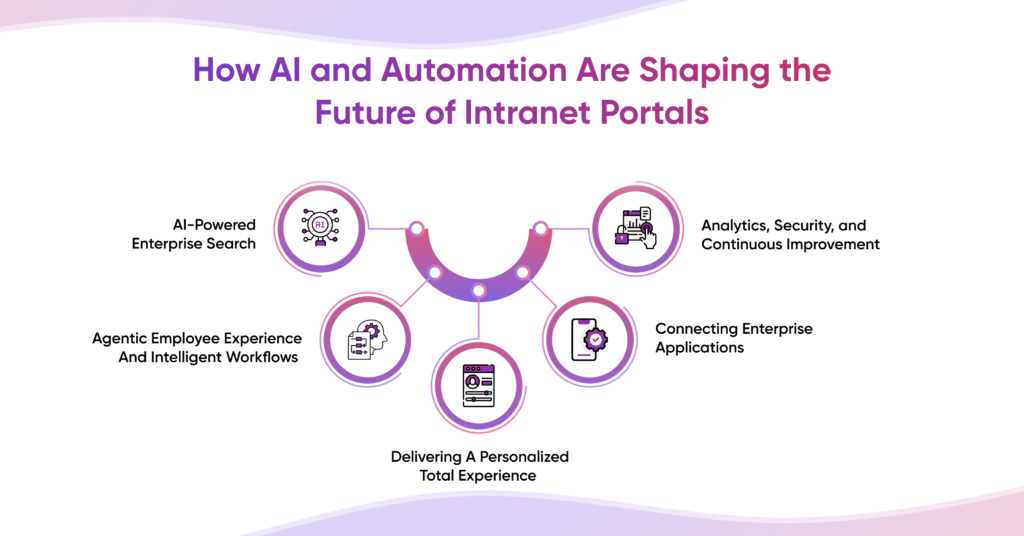
How AI and Automation Are Shaping the Future of Intranet Portals
-
AI-Powered Enterprise Search
One of the biggest challenges employees face is finding the right information quickly. Enterprise knowledge is often distributed across documents, applications, policies, FAQs, and internal resources.
AI-powered Enterprise Search changes this experience by understanding user intent instead of simply matching keywords. Employees can use natural language queries such as “What is the latest HR leave policy?“ and receive relevant, contextual results without navigating multiple folders or applications.
Modern intranets can also recommend relevant content, surface frequently used resources, and learn from employee search behavior.
Platforms like Liferay DXP can bring documents, content, media, FAQs, policies, and organizational resources together, helping create an Enterprise Knowledge Hub where employees spend less time searching and more time focusing on meaningful work.
-
Agentic Employee Experience and Intelligent Workflows
Automation has become an important part of enterprise operations, but the next evolution goes beyond basic rule-based automation.
Agentic AI enables AI agents to understand objectives, make contextual decisions, and execute multi-step processes with minimal human intervention.
In an employee intranet, this can simplify tasks such as:
- Leave requests
- Expense approvals
- Employee onboarding
- IT service requests
- Procurement requests
- Document approvals
Instead of manually identifying approvers, checking information, sending notifications, and tracking requests, AI can coordinate these activities across connected systems.
This creates an Agentic Employee Experience, where employees can focus on what they need rather than understanding which system they need to use.
Workflow Orchestration takes this further by connecting people, applications, data, approvals, and actions into a single process. For routine activities, Zero-Touch Workflows can automate repetitive steps and involve employees only when their input or decision is required.
-
Delivering a Personalized Total Experience
Modern employees expect workplace applications to offer the same level of personalization they experience with consumer platforms.
Today’s intelligent Digital Workplace can personalize content and services based on employee roles, departments, business units, locations, projects, and individual preferences.
For example, HR teams can see recruitment dashboards and policy updates, finance teams can access expense approvals, and sales teams can receive CRM updates and relevant notifications.
This moves the intranet towards Total Experience, where employee experience, digital interactions, enterprise applications, and business processes work together rather than existing as disconnected touchpoints.
-
Connecting Enterprise Applications
Employees often switch between multiple enterprise systems every day. This negatively impacts both productivity and the overall employee experience.
Modern intranet portals can integrate HRMS, ERP, CRM, Microsoft 365, Google Workspace, LMS, ITSM tools, and identity management through APIs, REST services, headless architecture, and connectors.
With Single Sign-On (SSO), employees can securely access connected applications through one interface.
However, integration should go beyond simply placing links to different applications on a portal. The real value comes from connecting these systems, so employees can find information, access applications, initiate workflows, and complete tasks through a more unified experience.
-
Analytics, Security, and Continuous Improvement
Building an intranet portal is only the beginning. Organizations need analytics to understand how employees interact with the platform.
Search trends, frequently accessed content, workflow completion times, application usage, portal adoption, and task completion metrics can reveal where employees experience friction.
For example, if employees repeatedly search for a policy but fail to find it, organizations can improve content organization or search relevance.
As intranets become central gateways to enterprise operations, security and governance are equally important. Modern solutions should support secure authentication, RBAC, MFA, encryption, audit trails, compliance, and scalable deployment.
Liferay DXP provides enterprise-grade security, flexible deployment options, and governance capabilities that support organizations as their digital workplace evolves.
Best Practices for Developing Future-Ready Intranet Portals
Organizations planning a next-generation Enterprise Intranet should:
Prioritize Employee Experience: Design around employee needs rather than organizational structure.
Build with AI and Automation in Mind: Identify repetitive processes that can benefit from AI, Agentic AI, and intelligent automation.
Create an Enterprise Knowledge Hub: Make policies, FAQs, training materials, and organizational knowledge easy to discover through Enterprise Search.
Connect Enterprise Systems: Integrate HRMS, ERP, CRM, collaboration tools, and ITSM platforms to reduce information fragmentation.
Design for Workflow Orchestration: Connect applications and processes so employees can complete tasks without unnecessary system switching.
Optimize Continuously: Use search, engagement, and workflow analytics to identify friction and improve the employee experience.
Why Choose Aixtor for Intranet Portal Development
Building an intelligent intranet requires more than technology; it demands a strategic understanding of enterprise workflows, employee experiences, and digital transformation.
At Aixtor Technologies, we help organizations design and develop modern intranet portals powered by Liferay DXP, with expertise in:
- Intranet portal consulting and digital workplace strategy
- End-to-end Intranet Portal Development
- Liferay DXP implementation and customization
- Employee self-service portal development
- Enterprise application integration
- AI-enabled workflow automation
- Secure, scalable architecture
- Ongoing support and optimization
Whether you’re modernizing an existing intranet or building a new enterprise portal, Aixtor helps create future-ready digital workplaces that simplify operations, improve collaboration, and enhance employee experiences.
Conclusion
The future of the Employee Intranet Portal extends far beyond internal communication and document storage. AI, Agentic AI, Enterprise Search, workflow automation, and Digital Experience Platforms like Liferay DXP are transforming intranets into intelligent digital workplaces.
As a Liferay Solution Partner, Aixtor Technologies helps organizations leverage Liferay DXP to build connected, scalable, and employee-focused digital experiences.
The real opportunity is to reduce the information fragmentation that forces employees to move between multiple systems. By creating an Enterprise Knowledge Hub, enabling an Agentic Employee Experience, connecting systems through Workflow Orchestration, and automating routine processes with Zero-Touch Workflows, organizations can make everyday work simpler and more connected.
Ultimately, Total Experience is about bringing people, knowledge, applications, and processes together in a way that works for the employee.
The enterprise of the future doesn’t make employees search harder. It makes finding answers and getting work done easier.
Latest Blogs
Stay up to date with the latest insights, trends, and best practices in enterprise portal development and digital transformation.


