
How Liferay AI Hub Enables Governed, AI-Powered Digital Experiences
About Author

Rajdip Vekariya

Full-Stack Liferay DXP Certified Developer with expertise in building scalable enterprise applications, leveraging modern web technologies, best practices, and AI-driven solutions to deliver intelligent, secure, and future-ready digital experiences.

AI can answer questions, create content, assist employees, and make digital experiences more useful. But for an enterprise, there is another question that comes before all of that: Can we use AI without losing control of our data, security, and processes?
As businesses bring AI into customer, employee, and partner experiences, governance becomes just as important as innovation with Liferay Consulting.
Liferay AI Hub addresses this balance by providing a centralized environment for building, deploying, and governing AI agents. As a standalone SaaS product that integrates with Liferay DXP, AI Hub can work with enterprise content and data while leveraging Liferay’s existing roles, permissions, and digital experience capabilities. Its governance capabilities include reusable instructions, configurable guardrails, agent permissions, and activity auditing, helping organizations introduce AI with greater control.
Why AI Governance Is Critical for Enterprise Digital Experiences
AI can make an enterprise portal considerably more useful. It can help users find answers faster, assist teams with content creation, and support more conversational digital experiences. But when AI starts interacting with real business information, things become more complicated.
Imagine an employee looking for an internal policy through an AI-powered experience. The employee wants a quick answer, but the organization also needs to make sure the AI does not surface information that the employee is not authorized to access.
The same applies to customer and partner experiences. A portal may contain account information, documents, contracts, business data, or other sensitive content. Giving AI access to this information without appropriate controls can introduce unnecessary risk.
This is why AI governance needs to develop alongside AI adoption. Organizations need clear policies, access controls, data protection practices, oversight, and compliance processes around how AI is used.
Good governance is not about putting a brake on innovation. It is about creating the controls that allow businesses to move forward with AI confidently.
How Liferay AI Hub Enables AI-Powered Digital Experiences
-
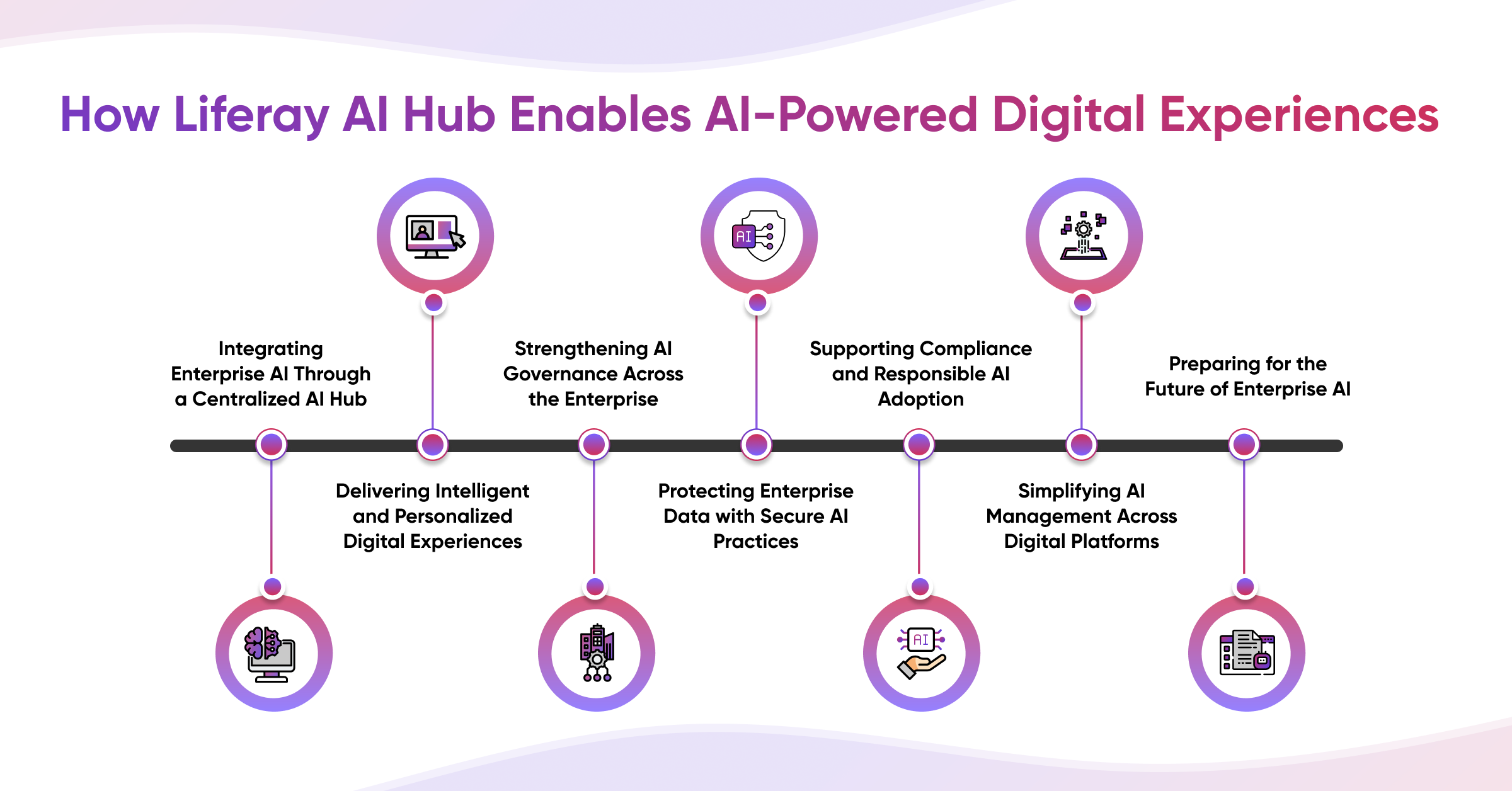
Build and Manage AI Agents Through a Centralized Environment
AI adoption can become fragmented surprisingly quickly.
One department may start experimenting with one AI model, another team may have a different use case, and individual teams may develop their own configurations. While this can work during early experimentation, managing AI becomes significantly more complex as adoption grows.
Liferay AI Hub provides a centralized environment for building, deploying, and governing AI agents across Liferay-powered digital experiences.
Its low-code environment helps organizations create and manage agents, configure their behavior, connect data sources, and establish governance controls without treating every AI initiative as an entirely separate project.
Depending on the AI Hub plan, organizations can use Liferay-provided language models or bring their own AI models, giving enterprises flexibility as their AI requirements evolve.
For IT teams, this means scaling AI does not necessarily have to mean creating a new management challenge every time the business introduces another AI-powered use case.
-
Ground AI Agents in Enterprise Information
An AI experience becomes more valuable when it can work with information that is relevant to the organization.
AI Hub allows agents to work with configured data sources and enterprise information, helping organizations create experiences that are grounded in the information users actually need.
For example, an employee could interact with an AI agent to find information from an internal knowledge base rather than manually navigating through multiple pages and documents.
The goal is not simply to add AI to an existing portal. It is to make information more accessible through useful, context-aware interactions while maintaining appropriate controls over the underlying data.
-
Apply Instructions and Guardrails to AI Behavior
One of the most important aspects of enterprise AI is controlling how agents behave.
Liferay AI Hub provides Instructions and Guardrails as part of its governance layer.
Instructions can provide reusable behavioral, brand, and policy guidance for agents, helping organizations establish consistent expectations for how AI should respond.
Guardrails provide another layer of control by evaluating inputs and outputs for risks such as prompt injection, sensitive data, harmful content, and other unwanted interactions.
This allows organizations to move beyond simply asking, “What can this AI agent do?” and also consider, “What should this AI agent be allowed to do?”
That distinction becomes increasingly important as AI moves from experimentation into real customer and employee workflows.
-
Enforce Roles and Permissions
Not every user should have the same level of access to AI capabilities.
AI Hub provides account roles and agent-level permissions that allow organizations to control who can manage and use AI agents. These include roles such as AI Hub Administrator, Agent Administrator, Agent Manager, and Agent Viewer.
When agents operate on Liferay DXP data, Liferay’s existing permission model can also help govern access to that information.
For example, if an employee does not have permission to access a confidential document, an AI-powered experience should not bypass that restriction simply because the AI can technically retrieve the information.
This combination of AI-specific permissions and existing platform access controls helps organizations introduce AI without treating it as an uncontrolled layer on top of their digital environment.
-
Connect AI With Liferay DXP Experiences and Workflows
AI becomes more useful when it is connected to the digital experiences and business processes where users already work.
Because AI Hub integrates with Liferay DXP, organizations can explore AI-powered experiences using their existing Liferay environment, content, identity, permissions, and digital experience capabilities.
AI-assisted content creation is one example. Liferay documents AI agents that can support activities such as content generation, writing tasks, categorization, tagging, and other content-related workflows.
AI Hub can also support conversational experiences that connect users with configured agents and information sources.
Liferay’s broader platform capabilities, including search and personalization, can complement these AI-powered experiences. The important distinction is that these should not automatically be treated as native AI Hub functionality.
-
Maintain Activity and Audit Visibility
Enterprise AI requires visibility into how AI is being used.
AI Hub provides activity and audit capabilities that can record information such as agent runs, guardrail violations, data-source retrievals, and changes to agent definitions. These records can help organizations understand what happened, when it happened, and which user or account triggered the activity.
This creates a more practical foundation for AI oversight.
Rather than relying only on policies written before deployment, organizations can also gain visibility into how agents are actually being used and where additional controls may be needed.
-
Protect Enterprise Data With Secure AI Practices
For most enterprises, the biggest AI question is not “What can AI do?” It is “What happens to our data when AI does it?”
Enterprise platforms can contain everything from customer records and employee information to confidential documents and internal knowledge. That makes data protection a central consideration when introducing AI.
When AI Hub agents operate with Liferay DXP data, they can leverage the platform’s existing access controls. Organizations should also configure each agent’s data sources and permissions appropriately.
At the same time, organizations should avoid assuming that all AI Hub data sources operate identically. AI Hub can also work with external website data sources, so data access and governance need to be considered based on the specific implementation.
The objective is straightforward: AI should make enterprise information more useful without weakening the controls that protect it.
-
Scale Governed AI Across the Enterprise
Managing one AI use case is relatively simple. Managing AI across multiple departments, portals, and business processes is a different story.
As organizations expand their use of AI, they need consistent approaches to agents, data sources, instructions, guardrails, permissions, and activity monitoring.
This is where a centralized AI environment can become valuable.
Instead of creating disconnected AI implementations for every new use case, organizations can build on an established approach to AI management and governance.
The long-term objective is not simply to deploy more AI agents. It is to create a scalable foundation where AI can become part of the enterprise digital strategy while governance remains part of the implementation.
AI Governance Best Practices for Enterprises
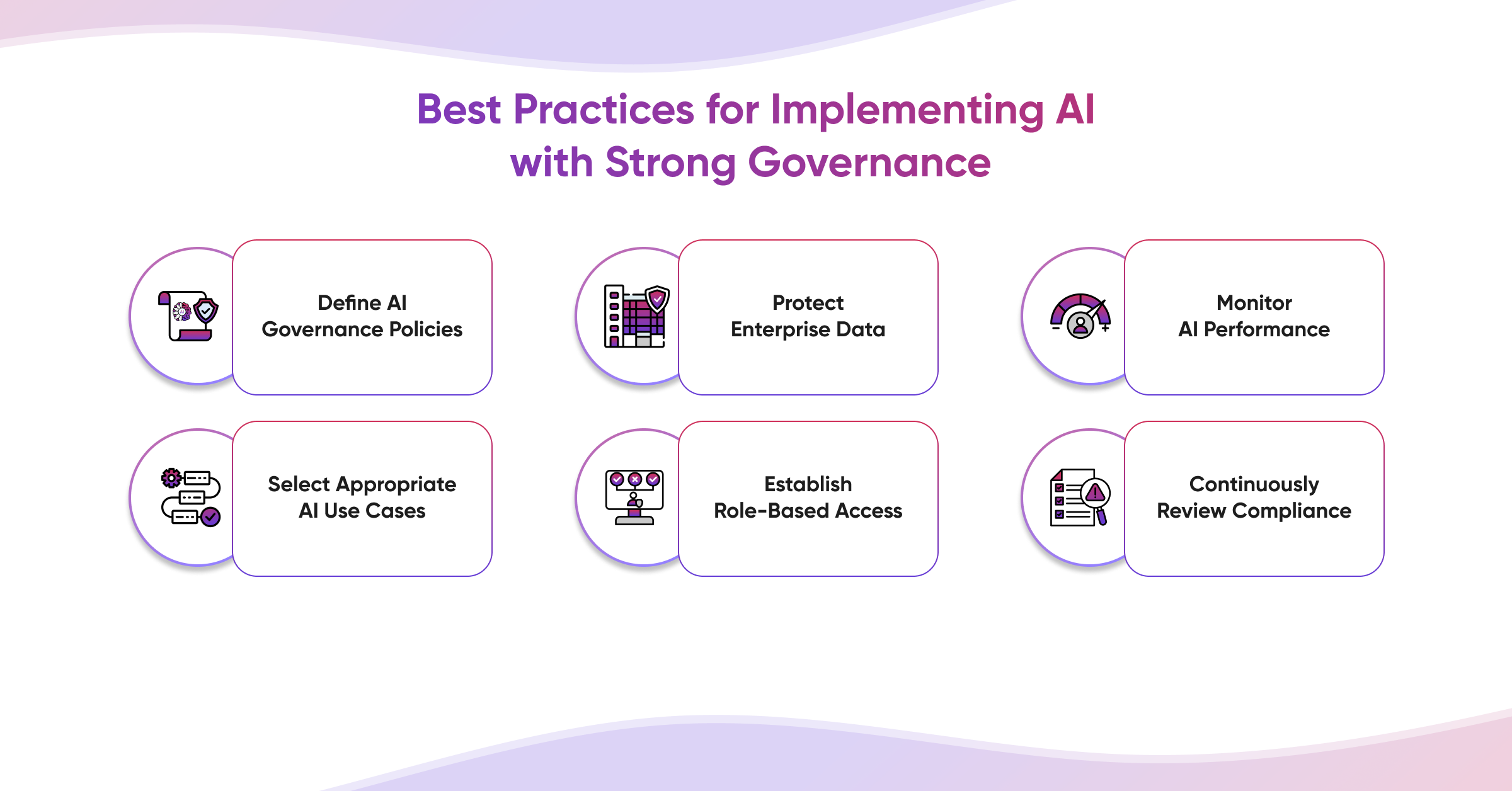
AI adoption works best when governance is built into the strategy from the beginning.
Define AI governance policies: Establish clear guidelines around acceptable AI use, data handling, access, accountability, and human oversight. These policies should be practical enough for business teams to understand and apply.
Select appropriate AI use cases: Do not introduce AI simply because it is available. Start with genuine business problems and evaluate each use case based on business value, feasibility, data requirements, and potential risk.
Protect enterprise data: Understand exactly what information each AI experience and agent can access. Sensitive information should remain protected, and organizations should configure appropriate permissions and data-source controls.
Establish role-based access: Different users have different responsibilities. Align AI access with appropriate roles and agent permissions so users receive only the capabilities relevant to them.
Use instructions and guardrails: Define how AI agents should behave and establish controls for potentially risky inputs and outputs.
Monitor AI activity and business outcomes: AI Hub’s activity and audit capabilities can provide visibility into agent usage and execution. Organizations should separately track outcomes such as adoption, task completion, accuracy, user satisfaction, and business impact.
Continuously review compliance: AI governance needs to evolve. As models, regulations, business requirements, and use cases change, organizations should regularly review their policies and controls.
Ultimately, strong governance creates a balance between innovation and control. It gives teams room to explore AI while giving IT, security, and business leaders greater confidence that adoption is happening responsibly.
Why Choose Aixtor for Liferay AI and Digital Experience Solutions
Introducing AI into a Liferay environment requires more than understanding AI technology. Enterprises also need expertise in Liferay DXP, digital experience architecture, integrations, security, upgrades, and platform modernization.
Aixtor helps organizations explore and implement evolving Liferay capabilities with a consultative approach focused on both business objectives and technical readiness.
Our capabilities include:
- Enterprise AI readiness
- Digital experience platform expertise
- Secure enterprise implementations
- Enterprise integrations
- End-to-end implementation and support
Whether an organization is preparing its Liferay environment for AI, modernizing an existing platform, or exploring new AI-powered digital experiences, Aixtor can help define a practical path from strategy to implementation.
The focus is not simply on adding AI. It is on making AI useful, secure, manageable, and aligned with the way the business actually works.
Conclusion
Liferay AI Hub gives enterprises a centralized environment for building, deploying, and governing AI agents while keeping governance, security, permissions, and operational visibility in focus.
As AI becomes part of customer, employee, and partner experiences, organizations need to think beyond what AI can do and consider how it should be used responsibly.
With capabilities such as Instructions, Guardrails, agent permissions, enterprise data connections, and activity auditing, AI Hub provides a foundation for introducing AI with greater control. At the same time, organizations still need their own policies, risk management, data governance, compliance processes, and human oversight.
The future of enterprise AI is not simply about adding more intelligent features. It is about creating digital experiences where AI can deliver value without compromising the control enterprises need.
Aixtor Technologies helps organizations modernize their Liferay environments and leverage evolving platform capabilities through expert consulting, upgrades, implementation, integrations, and ongoing digital experience support.
Latest Blogs
Stay up to date with the latest insights, trends, and best practices in enterprise portal development and digital transformation.


