
Why Automotive Ancillary Manufacturers Need a Modern Customer Self-Service Portal?
About Author

Nisarg Purohit

With 10+ years of experience in digital transformation and enterprise consulting, Nisarg helps businesses build scalable digital platforms across BFSI, NBFC, and Manufacturing. He bridges business strategy with technology to drive innovation, efficiency, and better customer engagement.
August 7, 2026

Digital transformation is reshaping the automotive manufacturing industry, and customer expectations are evolving just as quickly. OEMs, distributors, dealers, and enterprise buyers now expect the same level of speed, transparency, and convenience they experience in consumer applications. However, many automotive ancillary manufacturers still rely on traditional communication methods such as emails, phone calls, and manual document sharing to manage customer interactions.
As businesses scale, these disconnected processes often create delays, reduce visibility, and increase the workload for sales, finance, operations, and customer support teams.
A modern Customer Self-Service Portal addresses these challenges by providing customers with secure, anytime access to orders, invoices, product information, support, and business services. Rather than functioning as just another support channel, it becomes a centralized digital platform that strengthens customer relationships, improves operational efficiency, and supports long-term business growth.
Why Traditional Customer Engagement No Longer Works
Managing customer relationships through emails, spreadsheets, and phone calls may have worked when customer volumes were lower. Today, automotive ancillary manufacturers deal with multiple OEMs, distributors, dealers, and enterprise customers across different regions, making traditional communication increasingly inefficient.
Common challenges include:
- Endless email chains for order updates
- Phone-based order enquiries consuming sales teams
- Manual invoice and statement sharing
- Limited visibility into order status
- Multiple departments involved in every customer request
- Slow response times
- Fragmented communication across sales, finance, and operations
These manual processes not only delay customer responses but also reduce productivity and increase the risk of errors.
Industry research consistently shows that B2B buyers increasingly prefer digital self-service options for managing routine business interactions. Organizations that fail to meet these expectations risk lower customer satisfaction and reduced competitiveness.
What Is a Customer Self-Service Portal
A Customer Self-Service Portal is not simply another website or support system.
It is a secure digital workspace where customers can independently manage every stage of their business relationship with an organization.
Instead of contacting multiple departments for routine activities, customers can access information, complete transactions, submit requests, download documents, and track business activities from a single platform.
For automotive ancillary manufacturers, the portal becomes the central point for collaboration between customers and internal business teams.
What Can Customers Do Inside a Modern Customer Portal
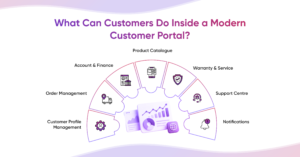
A modern customer portal enables customers to access the information and services they need without depending on manual communication.
Customer Profile Management
Customers can securely manage their business profiles and authorized users.
Capabilities include:
- Company profile management
- User management
- Multiple contact management
- Role-Based Access Control (RBAC)
Order Management
Customers gain complete visibility into their orders from placement through delivery.
Capabilities include:
- Place new orders
- Track order status
- View delivery progress
- Order history
- Repeat previous orders
Account & Finance
Financial information becomes easily accessible through a centralized dashboard.
Capabilities include:
- Invoice downloads
- Credit notes
- Outstanding payment details
- Account statements
- Payment history
Product Catalogue
Customers can access accurate product information whenever required.
Capabilities include:
- Product specifications
- Technical documentation
- CAD drawings
- Installation guides
- Product certifications
Warranty & Service
Post-sales services become faster and more transparent.
Capabilities include:
- Warranty registration
- Service request submission
- Warranty claim tracking
- Product return management
Support Centre
Customers can resolve issues more efficiently through self-service resources.
Capabilities include:
- Raise support tickets
- Live chat support
- Frequently Asked Questions (FAQs)
- Knowledge base
Notifications
Customers stay informed through real-time business updates.
Notifications include:
- Shipment updates
- Product announcements
- Price updates
- Maintenance alerts
It’s Not Just for Customers How Internal Teams Benefit
A Customer Self-Service Portal improves efficiency across the entire organization by reducing manual work and providing real-time access to business information.
Sales Team
Sales teams spend less time responding to routine enquiries and more time building customer relationships.
Benefits include:
- Better customer engagement
- Faster quotation management
- Cross-selling opportunities
- Upselling opportunities
- Customer insights
- Improved revenue forecasting
Finance Team
Finance departments benefit from automation and improved visibility into customer accounts.
Benefits include:
- Automated invoice sharing
- Outstanding payment visibility
- Credit management
- Reduced administrative effort
- Faster payment collection
Customer Support
Support teams can resolve customer issues more efficiently while reducing repetitive enquiries.
Benefits include:
- Lower ticket volumes
- Faster issue resolution
- Better SLA compliance
- Self-service knowledge base
Operations Team
Operations teams gain improved visibility into customer demand and order progress.
Benefits include:
- Real-time order visibility
- Better production planning
- Shipment tracking
- Reduced customer follow-ups
Management Team
Business leaders gain access to actionable insights through centralized dashboards.
Benefits include:
- Revenue projections
- Customer activity monitoring
- Order trends
- Product demand analysis
- Customer engagement insights
- Business analytics
Accelerating New Product Development Through Digital Collaboration
Customer portals can play a much larger role than managing orders and support requests. They also create a collaborative environment where customers actively participate in product development.
Through a centralized digital platform, manufacturers can streamline product feedback, engineering discussions, drawing approvals, and prototype evaluations without relying on fragmented email communication.
Digital collaboration capabilities include:
- Product feedback collection
- Design collaboration
- Engineering communication
- CAD drawing approvals
- Prototype discussions
- Sample approvals
- Product lifecycle collaboration
This collaborative approach helps manufacturers reduce development cycles, improve product quality, and strengthen long-term customer partnerships.
Business Outcomes Beyond Customer Convenience
The value of a customer portal extends well beyond convenience. It delivers measurable business improvements that support growth and operational excellence.
Key business outcomes include:
- Better customer experience
- Higher customer retention
- Reduced operational costs
- Increased employee productivity
- Faster order processing
- Better revenue forecasting
- Stronger customer relationships
- Improved cross-functional collaboration
- Data-driven business decisions
Building an Integrated Digital Ecosystem
A customer portal is most effective when it connects with existing enterprise applications rather than replacing them.
Modern customer portals integrate with:
- Logistics systems
- Product Lifecycle Management (PLM)
- CRM platforms
- Identity Management solutions
- Payment gateways
These integrations provide customers with accurate, real-time information while eliminating duplicate data entry and disconnected workflows.
From Customer Portal to Enterprise Digital Experience Platform
As business requirements evolve, organizations often need additional digital capabilities beyond customer self-service. A modern platform can expand to support dealer portals, supplier portals, employee portals, service portals, and partner collaboration without requiring separate systems.
By building a unified digital experience platform, manufacturers can create connected experiences across every stakeholder while maintaining consistent governance, security, and integrations.
Choosing the Right Platform for Long-Term Growth
Selecting the right customer portal platform is a long-term strategic decision. Manufacturers should evaluate platforms based on their ability to support future growth and evolving business needs.
Key considerations include:
- Scalability to support business growth
- Secure role-based access
- ERP, CRM, and PLM integration capabilities
- Configurable workflows
- Mobile-friendly experience
- Built-in analytics and reporting
- Flexibility to expand into dealer, supplier, and employee portals
Choosing a scalable platform ensures organizations can continue adding new digital capabilities without replacing their existing investment.
Conclusion
Automotive ancillary manufacturers are under increasing pressure to improve customer experiences while operating more efficiently in an increasingly competitive market. A modern Customer Self-Service Portal addresses both priorities by connecting customers, sales, finance, operations, and product teams through a single digital experience. Aixtor Technologies helps organizations build scalable digital solutions that support these connected customer experiences. Beyond simplifying everyday interactions, it creates greater transparency, accelerates collaboration, and supports informed decision-making across the organization.
As digital expectations continue to rise, organizations that invest in a scalable customer portal today will be better positioned to strengthen customer relationships, streamline operations, and build a connected digital ecosystem that supports long-term business growth.
Latest Blogs
Stay up to date with the latest insights, trends, and best practices in enterprise portal development and digital transformation.


