
AI Agent Governance: How Enterprises Can Scale AI Securely with Liferay
About Author

Rajdip Vekariya

Full-Stack Liferay DXP Certified Developer with expertise in building scalable enterprise applications, leveraging modern web technologies, best practices, and AI-driven solutions to deliver intelligent, secure, and future-ready digital experiences.

Introduction: The Growing Need for AI Agent Governance
Enterprise AI is moving beyond standalone assistants that answer questions or generate content. Organizations are increasingly exploring AI agents that can coordinate tasks, interact with business applications, retrieve information, and execute actions across different systems. With expert Liferay consulting, businesses can also explore opportunities to integrate AI capabilities into their enterprise digital platforms, streamline workflows, and build more connected digital experiences.
Consider a financial services organization using separate AI agents for customer onboarding, document verification, loan processing, and internal support. Each agent serves a specific purpose, but they may also interact with overlapping datasets, applications, and business workflows.
This raises an important question: How can enterprises ensure that every AI agent operates within clearly defined boundaries?
As AI becomes more deeply integrated into business operations, organizations need more than intelligent automation. They need a structured approach to managing agent permissions, monitoring activities, protecting enterprise information, and maintaining accountability.
Without proper governance, the same autonomy that makes AI agents valuable can introduce security vulnerabilities, operational inconsistencies, and compliance challenges. This makes AI agent governance an essential part of building a secure and scalable enterprise AI ecosystem.
Why AI Agent Governance Matters for Enterprises
When AI agents become part of everyday business operations, their decisions and actions can directly influence organizational outcomes. An incorrect response may be inconvenient, but an unauthorized transaction, inappropriate data disclosure, or incorrectly updated business record can have much larger consequences.
For enterprises managing multiple AI-powered workflows, the absence of governance can introduce several challenges.
Excessive Access to Enterprise Resources: AI agents connected to multiple enterprise applications may have access to more information than their assigned responsibilities require. Without granular permission controls, sensitive employee, customer, or financial information could become accessible through unintended interactions.
Unreliable Decision-Making Across Workflows: AI-generated outputs depend on the instructions, information, and context available to an agent. Inconsistent data sources or outdated information can lead to conflicting recommendations, affecting business processes and the quality of decisions.
Increased Exposure to Data Security Risks: Enterprise AI workflows frequently involve information moving between internal platforms, external models, APIs, and connected services. Every integration introduces additional considerations around data handling, confidentiality, and security.
Difficulty Establishing Accountability: When an AI agent performs an action, organisations need to understand what information influenced it, what instructions it followed, and which systems it interacted with. Without sufficient activity records, identifying the source of an issue becomes challenging.
Uncontrolled Automation in Business Processes: Allowing agents to execute tasks without clearly defined approval requirements can create operational problems. Actions such as approving financial requests, modifying customer records, or initiating transactions may require additional validation before execution.
Effective governance helps enterprises establish responsibility at every stage of an AI workflow. It defines which activities can be automated, which require human intervention, and how organization’s can maintain oversight without restricting the benefits of intelligent automation.
Key Principles for Secure AI Agent Deployment
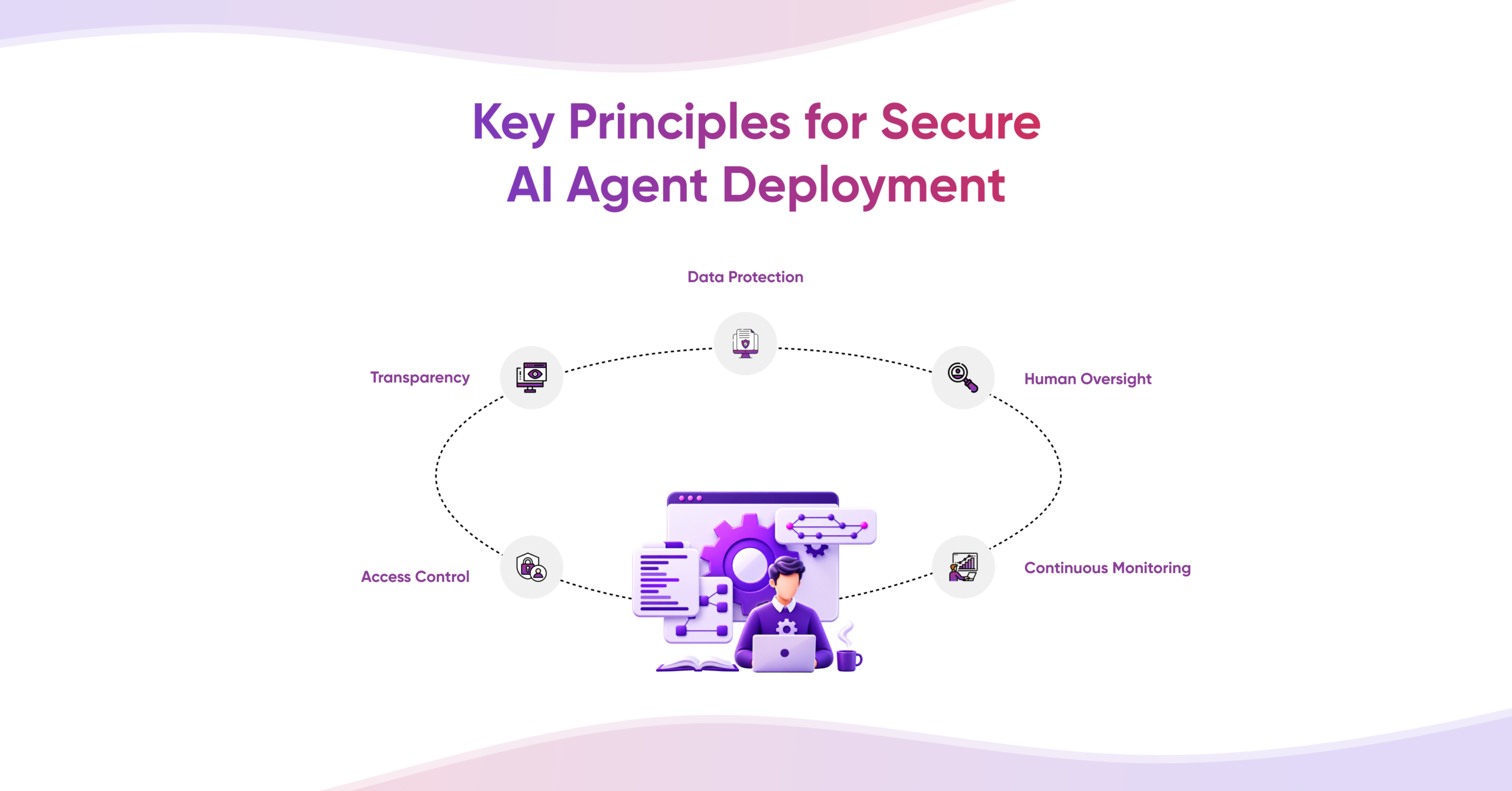
Deploying AI agents across an enterprise requires a consistent framework for managing their access, behavior, interactions, and outputs. Rather than treating governance as a one-time security exercise, organization’s should establish practices that remain relevant throughout an agent’s lifecycle.
Five essential considerations can help create this foundation.
-
Access Control
Assign permissions according to the specific responsibilities of each AI agent. An agent supporting customer service may need access to customer interaction history, while an agent handling HR queries may require access to employee policies. Neither should automatically inherit unrestricted access to enterprise resources.
-
Transparency
Maintain visibility into how AI agents interact with information and execute tasks. Recording relevant interactions, data access, and actions performed helps IT and compliance teams investigate unexpected behavior and establish accountability.
-
Data Protection
Protect information as it moves between AI models, enterprise applications, and connected data sources. Organization’s should evaluate integration permissions, encryption requirements, data-sharing policies, and the handling of confidential information.
-
Human Oversight
AI agents can automate repetitive activities, but certain decisions should remain subject to human validation. For example, financial approvals, sensitive account modifications, and high-impact business decisions may require an authorized employee’s approval before execution.
-
Continuous Monitoring
Governance should extend beyond deployment. Regularly assess agent responses, access patterns, workflow execution, and adherence to organizational policies. This helps identify unexpected behavior and maintain reliability as business requirements evolve.
These practices allow enterprises to establish a controlled operating environment for AI agents. More importantly, they ensure that security, accountability, and operational reliability remain part of the AI adoption strategy rather than becoming afterthoughts.
How Liferay Supports Governed Enterprise AI
Enterprises looking to introduce AI into their digital ecosystems do not necessarily need to rebuild their existing infrastructure. A more practical approach is to extend established enterprise platforms with AI capabilities while maintaining the access policies, content structures, and workflows that already support business operations.
This is where Liferay DXP and Liferay AI Hub can play an important role in enabling governed enterprise AI experiences.
Liferay DXP: Establishing the Enterprise Access Foundation
Liferay DXP provides a structured environment for managing enterprise content, applications, users, and permissions. Through Liferay DXP upgrade services, organizations can keep their platform updated while leveraging role-based access control (RBAC) capabilities to define who can access specific resources and perform particular activities.
For example, within an enterprise employee portal, an employee, department manager, and HR administrator may have different levels of access to organizational information. These distinctions become particularly important when AI capabilities are introduced into the same environment.
By maintaining defined access policies across digital experiences, organizations can establish an important foundation for introducing AI without overlooking existing information security requirements.
While Liferay DXP provides the foundation for managing enterprise users, content, permissions, and digital experiences, Liferay AI Hub extends this environment with capabilities for building and orchestrating AI agents. Together, they enable organisations to introduce AI-powered interactions into their digital ecosystems while maintaining appropriate access controls, data governance practices, and oversight across connected systems.
Liferay AI Hub: Bringing AI Agents into Enterprise Workflows
Liferay AI Hub is a low-code SaaS environment that enables organizations to build, configure, and manage AI agents. Teams can create custom agents, define their workflows, connect data sources, and configure instructions and guardrails to guide agent behaviour. It also supports integrations with AI models and MCP servers.
The availability of certain AI Hub capabilities depends on the selected subscription plan. Liferay offers different tiers with varying levels of agent customization, external system connectivity, access controls, and audit capabilities. Organizations should evaluate these options based on their integration requirements, governance needs, and expected scale of AI adoption.
Here are some ways its capabilities contribute to governed AI deployment:
-
Agent Management and Access
Organization’s can create and manage agents according to their business requirements. AI Hub provides account-level roles for managing access across agents, while custom agents also support individual permission settings to control specific user actions. Access to enterprise information must be configured appropriately across connected data sources and applications to ensure that agents retrieve only authorized information.
-
Configurable Instructions
Administrators can establish reusable instructions that define how agents should respond, what policies they should follow, and how they should handle specific situations. This helps maintain consistent behavior across agents serving different business functions.
-
Guardrails for AI Interactions
Liferay AI Hub supports configurable input and output guardrails that help screen AI interactions for potential security and safety concerns. Input guardrails can identify risks such as prompt injection, jailbreak attempts, and sensitive information, while output guardrails help screen generated responses for inappropriate or potentially harmful content. These controls provide an additional layer of protection and should be configured according to the requirements of individual AI agents.
-
Contextual Enterprise Information
Through connected data sources and retrieval-augmented generation (RAG), AI agents can use relevant organizational information to generate more context-aware responses. This reduces reliance on general model knowledge when answering questions about enterprise-specific policies, documents, and processes.
-
Flexible AI Integrations
AI Hub supports Model Context Protocol (MCP) servers, allowing organization’s to connect compatible tools and external systems. This provides flexibility when incorporating AI capabilities into existing digital environments and business workflows.
-
Activity Tracking and Visibility
Liferay AI Hub maintains records of agent execution activities, data retrieval, guardrail violations, and changes to agent definitions. These records provide administrators with an auditable view of agent activity, helping support operational reviews, troubleshooting, and governance oversight.
Bringing It Together: An Enterprise Use Case
Consider an employee using an AI assistant within an internal knowledge portal to understand the organization’s travel reimbursement policy.
Instead of navigating multiple documents or contacting the HR department, the employee can ask a question and receive a contextual response based on relevant organizational information.
Behind this experience, the organization can configure instructions to guide the agent’s responses, assign appropriate guardrails to screen interactions, and connect relevant enterprise data sources. Access permissions and connected-system configurations also need to be designed appropriately to prevent information from being exposed beyond authorized boundaries.
This illustrates how Liferay’s digital experience capabilities and AI Hub can work together to support more controlled, context-aware enterprise AI experiences.
It is important to recognize that secure AI deployment involves more than the capabilities of an individual platform. Enterprises must also account for model-level security, connected application permissions, data governance, integration configurations, and ongoing evaluation. Liferay can provide important building blocks within this broader governance approach.
How Aixtor Helps Enterprises Scale AI Securely
Implementing governed AI across an enterprise requires more than selecting the right AI platform. Organization’s must understand their existing infrastructure, define access requirements, establish secure data connections, and ensure that AI capabilities align with business workflows.
Aixtor helps organization’s address these requirements through its Liferay consulting, enterprise portal development, and AI integration expertise.
From extending Liferay DXP capabilities to integrating AI-powered solutions, Aixtor focuses on building digital environments that support secure and scalable AI adoption.
Its implementation approach can support enterprises across several areas:
Enterprise Access Architecture: Configuring user roles, permissions, and access structures within Liferay environments to support controlled information access.
AI Agent Integration: Integrating AI capabilities into enterprise portals and digital experiences based on specific business requirements.
Enterprise Data Connectivity: Connecting relevant enterprise information sources and applications while accounting for their respective access and security requirements.
Workflow Customization: Extending existing business workflows with AI-enabled capabilities to improve operational efficiency.
Platform Enhancement: Customizing and extending Liferay DXP environments to accommodate evolving enterprise AI requirements.
Whether an organization is introducing AI-powered capabilities into an existing enterprise portal or exploring intelligent workflows for customer and employee experiences, Aixtor helps connect business objectives with the right technology approach.
By combining enterprise platform expertise with an understanding of emerging AI capabilities, Aixtor supports organization’s in building digital ecosystems where security, usability, and operational control remain central to AI adoption.
Conclusion: Build Trust as You Scale AI
AI agents are becoming an increasingly important part of how enterprises manage information, coordinate processes, and deliver digital experiences. However, scaling these capabilities successfully requires organization’s to think beyond automation and consider the controls that make intelligent systems dependable.
A well-defined governance approach gives enterprises the confidence to introduce AI into more business functions while maintaining visibility, protecting sensitive information, and ensuring that critical activities remain accountable.
As AI adoption continues to evolve, organization’s that establish these foundations early will be better prepared to expand their AI capabilities without losing control of their digital ecosystems.
The objective is not to limit what AI agents can accomplish, but to create an environment where they can operate with clearly defined responsibilities, appropriate permissions, and the necessary oversight.
Ready to bring governed AI capabilities into your enterprise ecosystem? Connect with Aixtor to explore how Liferay can support your journey towards secure, intelligent, and scalable digital experiences.
Latest Blogs
Stay up to date with the latest insights, trends, and best practices in enterprise portal development and digital transformation.


