
Telecom Partner Portal Solutions: Key Features and Benefits
About Author

Nisarg Purohit

With 10+ years of experience in digital transformation and enterprise consulting, Nisarg helps businesses build scalable digital platforms across BFSI, NBFC, and Manufacturing. He bridges business strategy with technology to drive innovation, efficiency, and better customer engagement.
August 12, 2026

The telecom industry relies on a vast network of distributors, resellers, dealers, franchise partners, and service providers to deliver products and services efficiently. As partner ecosystems continue to grow, managing these relationships manually becomes increasingly complex. Telecom partner portal solutions simplify collaboration by centralizing partner operations, improving communication, and streamlining workflows. In this blog, we’ll explore why telecom businesses need partner portals, their key features, and how they drive long-term business growth.
Why Telecom Businesses Need Partner Portal Solutions
Telecom companies rarely operate alone. Their success depends on an extensive partner ecosystem responsible for customer acquisition, product distribution, support services, and market expansion. While this network creates growth opportunities, it also introduces operational complexity.
Many telecom organizations still rely on emails, spreadsheets, shared drives, and disconnected systems to manage partner relationships. As the number of partners increases, these traditional methods become difficult to scale and often lead to inefficiencies.
Some of the most common challenges include:
Growing Dealer and Distributor Networks
Telecom businesses constantly onboard new distributors, retailers, channel partners, and franchise operators. Managing thousands of partner relationships without a centralized system becomes increasingly difficult and time-consuming.
Manual Partner Management
Manual registration processes, document verification, contract approvals, and partner updates consume valuable administrative time while increasing the likelihood of human errors.
Communication Gaps
Partners often struggle to access the latest pricing, product information, marketing materials, promotional campaigns, or policy updates. Inconsistent communication can directly affect sales performance and customer experience.
Delayed Partner Onboarding
Without automated onboarding workflows, new partners may wait days or even weeks before receiving approvals, credentials, product training, or access to essential resources.
Limited Partner Visibility
Sales teams and channel managers often lack real-time visibility into partner performance, pipeline status, lead progress, and engagement metrics, making it difficult to make informed business decisions.
A telecom partner portal addresses these challenges by centralizing partner operations on a single platform, enabling seamless collaboration, improved visibility, and greater operational efficiency.
Key Features of Telecom Partner Portal Solutions
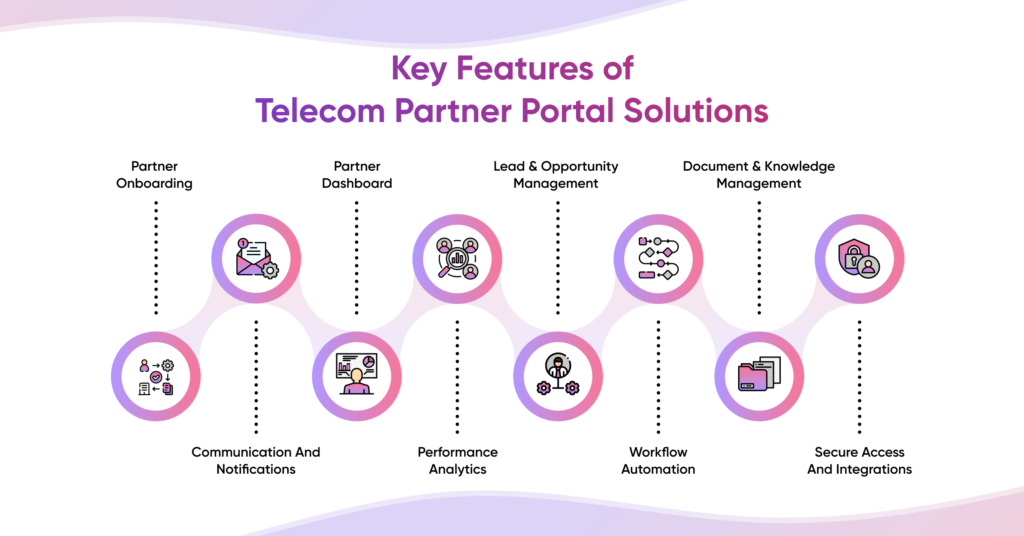
A modern telecom partner portal is much more than a document repository. It serves as a centralized digital workspace where partners can access everything they need to succeed.
- Partner Onboarding
A smooth onboarding experience helps new partners become productive faster.
An effective partner portal should support:
- Online partner registration
- Digital document submission
- Automated approval workflows
- Product training and certification resources
- Self-service profile management
Automated onboarding reduces administrative workload while ensuring every partner follows standardized processes.
- Partner Dashboard
A personalized dashboard provides partners with instant access to the information they need daily.
Key capabilities include:
- Personalized home dashboard
- Quick access to sales resources
- Product updates
- Pending tasks
- Performance overview
- Recent announcements
Instead of navigating multiple systems, partners can manage their activities from a single interface.
- Lead & Opportunity Management
Efficient lead management improves channel sales performance and prevents conflicts between partners.
Essential capabilities include:
- Lead assignment integrated with CRM systems
- Opportunity tracking
- Lead status updates
- Sales collaboration
- Opportunity ownership visibility
This ensures leads reach the right partners while providing transparency throughout the sales cycle.
- Document & Knowledge Management
Partners need immediate access to accurate and updated business resources.
A centralized knowledge hub should include:
- Product documentation
- Sales collateral
- Marketing assets
- Pricing documents
- Contracts
- FAQs
- Training materials
- Knowledge base articles
Version-controlled documentation ensures partners always work with the latest information.
- Communication & Notifications
Keeping partners informed is critical for maintaining engagement and consistency.
Partner portals should offer:
- Company announcements
- Product launch notifications
- Promotional campaign updates
- Event invitations
- Internal messaging
- Automated alerts
- Policy change notifications
Centralized communication reduces email dependency while improving information accessibility.
- Performance Analytics
Data-driven insights help both telecom businesses and partners improve performance.
Analytics capabilities include:
- Sales dashboards
- Revenue tracking
- KPI monitoring
- Performance scorecards
- Lead conversion reports
- Partner rankings
- Custom reports
These insights enable channel managers to identify high-performing partners and provide targeted support where needed.
- Workflow Automation
Automation eliminates repetitive administrative tasks and accelerates business operations.
Typical automated workflows include:
- Partner approvals
- Document verification
- Contract renewals
- Lead assignment
- Task notifications
- Escalation workflows
- Approval reminders
By reducing manual intervention, businesses can improve operational efficiency while minimizing delays.
- Secure Access & Integrations
Security and seamless connectivity are essential for enterprise telecom operations.
A robust partner portal should provide:
- Role-based access control
- Single Sign-On (SSO)
- Multi-factor authentication
- CRM integration
- ERP integration
- API connectivity
- Secure document access
- Enterprise-grade authentication
Integrating the portal with existing enterprise systems creates a unified digital ecosystem while ensuring sensitive business information remains protected.
Business Benefits of Telecom Partner Portal Solutions
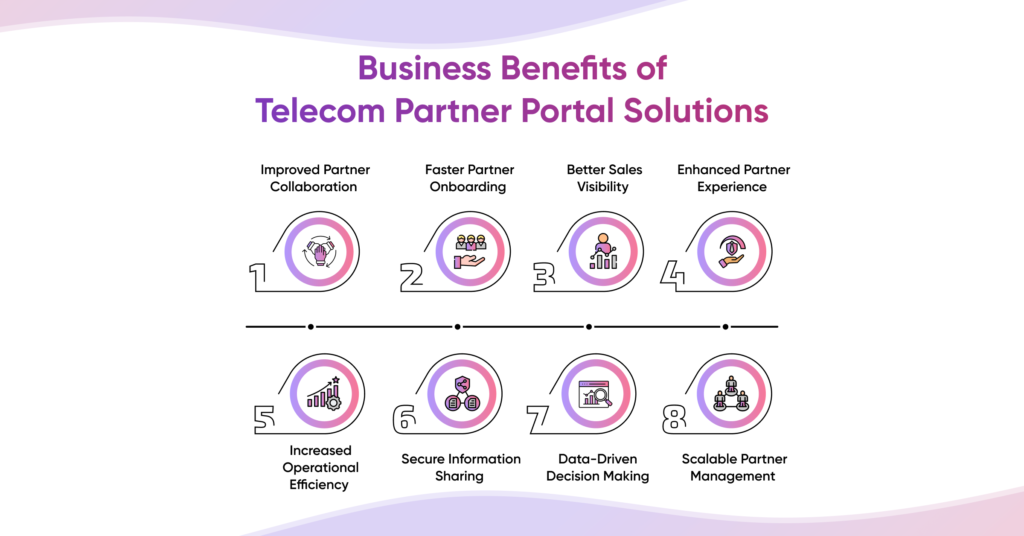
The true value of a partner portal lies in how these capabilities improve day-to-day business operations and long-term growth.
Improved Partner Collaboration
Centralized communication, shared resources, and collaborative workflows enable stronger relationships between telecom businesses and their partners.
Faster Partner Onboarding
Automated registration, approvals, and training significantly reduce the time required for new partners to become operational.
Better Sales Visibility
Real-time dashboards provide complete visibility into leads, opportunities, sales performance, and partner engagement, helping managers make informed decisions.
Enhanced Partner Experience
Self-service capabilities allow partners to access information, complete tasks, and find resources independently, resulting in greater satisfaction and engagement.
Increased Operational Efficiency
Workflow automation reduces administrative workload, eliminates repetitive tasks, and improves productivity across partner management teams.
Secure Information Sharing
Role-based permissions and enterprise-grade security ensure confidential business information is only accessible to authorized users.
Data-Driven Decision Making
Comprehensive analytics and reporting help telecom businesses identify trends, evaluate partner performance, and optimize channel strategies.
Scalable Partner Management
As telecom businesses expand into new markets or onboard additional channel partners, a scalable partner portal grows alongside the organization without increasing operational complexity.
Choosing the Right Partner Portal Solution for the Telecom Industry
Selecting the right partner portal requires more than choosing a platform with standard collaboration features. Telecom businesses need a solution capable of supporting enterprise-scale operations, complex partner networks, and future business growth.
When evaluating a telecom partner portal solution, consider the following:
Telecom Industry Expertise
Choose a technology partner that understands telecom business processes, channel operations, and partner ecosystems.
Customizable Workflows
Every telecom organization has unique onboarding, approval, sales, and operational requirements. The platform should allow workflow customization without extensive redevelopment.
CRM & ERP Integration
The partner portal should seamlessly integrate with existing CRM, ERP, billing, and enterprise applications to eliminate data silos.
Enterprise-Grade Security
Look for robust security capabilities, including role-based permissions, authentication, encryption, and compliance with enterprise security standards.
Scalable Architecture
As partner networks expand, the platform should support increasing users, transactions, and integrations without compromising performance.
Analytics & Reporting
Advanced dashboards and reporting tools should provide actionable insights into partner performance, sales, engagement, and operational efficiency.
Mobile Accessibility
Partners increasingly work remotely. Mobile-responsive experiences help users access critical resources anytime, anywhere.
Ongoing Support & Maintenance
Long-term success depends on continuous platform enhancements, performance optimization, security updates, and technical support from an experienced implementation partner.
Why Choose Aixtor Technologies
At Aixtor Technologies, we help enterprises build secure, scalable, and user-centric digital experiences that strengthen partner relationships and improve operational efficiency. With extensive experience in enterprise portal development, we deliver customized telecom partner portal solutions designed around each organization’s business goals.
Leveraging the capabilities of Liferay DXP, we develop modern partner portals that simplify partner onboarding, streamline channel collaboration, centralize knowledge management, automate workflows, and provide real-time business insights.
Our telecom partner portal solutions offer:
- Enterprise-grade portal development expertise
- Telecom-focused digital solutions
- Scalable architecture built for growing partner ecosystems
- Secure integration with CRM, ERP, and third-party enterprise applications
- Role-based access control and enterprise security
- Personalized user experiences
- Workflow automation for faster operations
- Long-term support, optimization, and platform enhancements
By combining our technical expertise with the flexibility of Liferay DXP, we help telecom businesses create connected digital ecosystems that enhance partner productivity and accelerate business growth.
Conclusion
Managing an expanding telecom partner ecosystem requires more than manual processes and disconnected systems. A modern telecom partner portal provides a centralized platform for onboarding, communication, collaboration, sales management, knowledge sharing, workflow automation, and performance analytics.
By improving partner engagement, increasing operational efficiency, strengthening security, and enabling data-driven decision-making, telecom businesses can build stronger channel relationships while scaling confidently in a competitive market.
At Aixtor Technologies, we design and develop enterprise-grade partner portal solutions powered by Liferay DXP that help telecom organizations modernize partner management, improve collaboration, and drive sustainable business growth. Whether you’re looking to streamline channel operations or build a scalable digital partner ecosystem, our team can help you create a solution tailored to your business needs.
Latest Blogs
Stay up to date with the latest insights, trends, and best practices in enterprise portal development and digital transformation.


